Why true infection-control cleaning is more than fogging, spraying, or a one-off “deep clean”
What Is the Difference Between Cleaning, Sanitising, and Disinfecting?
Sanitising reduces the number of bacteria on a surface to a level considered safe by public health standards. It is a step up from cleaning but is not designed to eliminate viruses or all types of bacteria.
Term | What it does | What it does not do |
Cleaning | Removes dirt, grease, organic matter; reduces microbial load | Does not reliably kill viruses or bacteria |
Sanitising | Reduces bacteria to a safe public health level | Does not eliminate viruses or all bacteria |
Disinfecting | Kills or deactivates viruses and bacteria on a clean surface | Cannot work effectively on a dirty surface |
Why Must Cleaning Always Happen Before Disinfection?
The National Health and Medical Research Council (NHMRC) in Australia confirms that to kill germs, any disinfectant must be applied to a surface that is already clean and dry, used at the right concentration, and left in contact with the surface for the required time. Skip any one of those steps and the product fails.
Is Complete Sanitisation of a Workplace Actually Possible?
This is why the goal of commercial cleaning should never be “complete sanitisation.” It should be a systematic, ongoing hygiene maintenance plan that interrupts the chain of infection as consistently as possible.
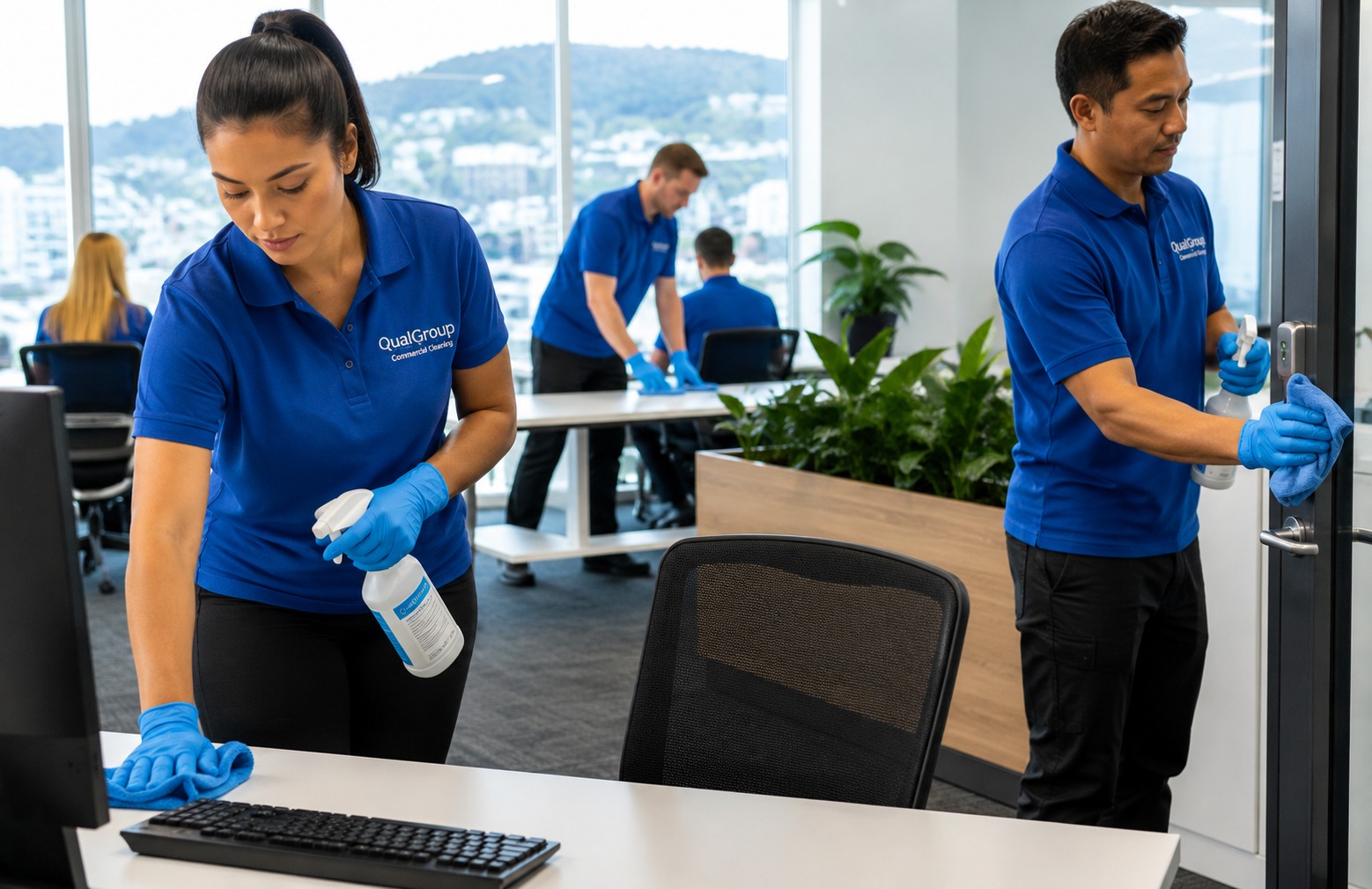
The most effective way to do that is by focusing relentlessly on High Touch Points (HTPs) — the surfaces that multiple hands touch throughout the day. These carry far more infection risk than a rarely-touched wall or ceiling. Cleaning those surfaces frequently, correctly, and with validated products is where infection control actually happens.
What Are High-Touch Points and Why Do They Matter More Than Everything Else?
Entry and Common Areas
- Door handles and push plates
- Light switches and security keypads
- Lift buttons and hand railings
- Reception counters
- Sign-in touch screens
- Shared office equipment (printers, photocopiers, phones)
- Meeting room table surfaces and chair arms
Kitchen and Eating Areas
- Tap handles and benchtops
- Fridge, microwave, and appliance handles
- Cupboard handles
- Dining tables and chair arms
- Urn and kettle handles
Bathrooms
- Tap handles and basin benches
- Soap dispenser pumps
- Paper towel dispensers and hand dryer buttons
- Door push plates and handles
Toilets and Cubicles
- Toilet flush buttons
- Toilet seat fronts and lids
- Cubicle door locks
- Sanitary bin lids
- Safety railings
In high-risk environments such as aged care facilities and childcare centres, all hard surfaces should be treated as HTPs and cleaned with increased frequency.
Why Is Dwell Time the Most Overlooked Factor in Commercial Disinfection?
Does Disinfectant Fogging Actually Work?
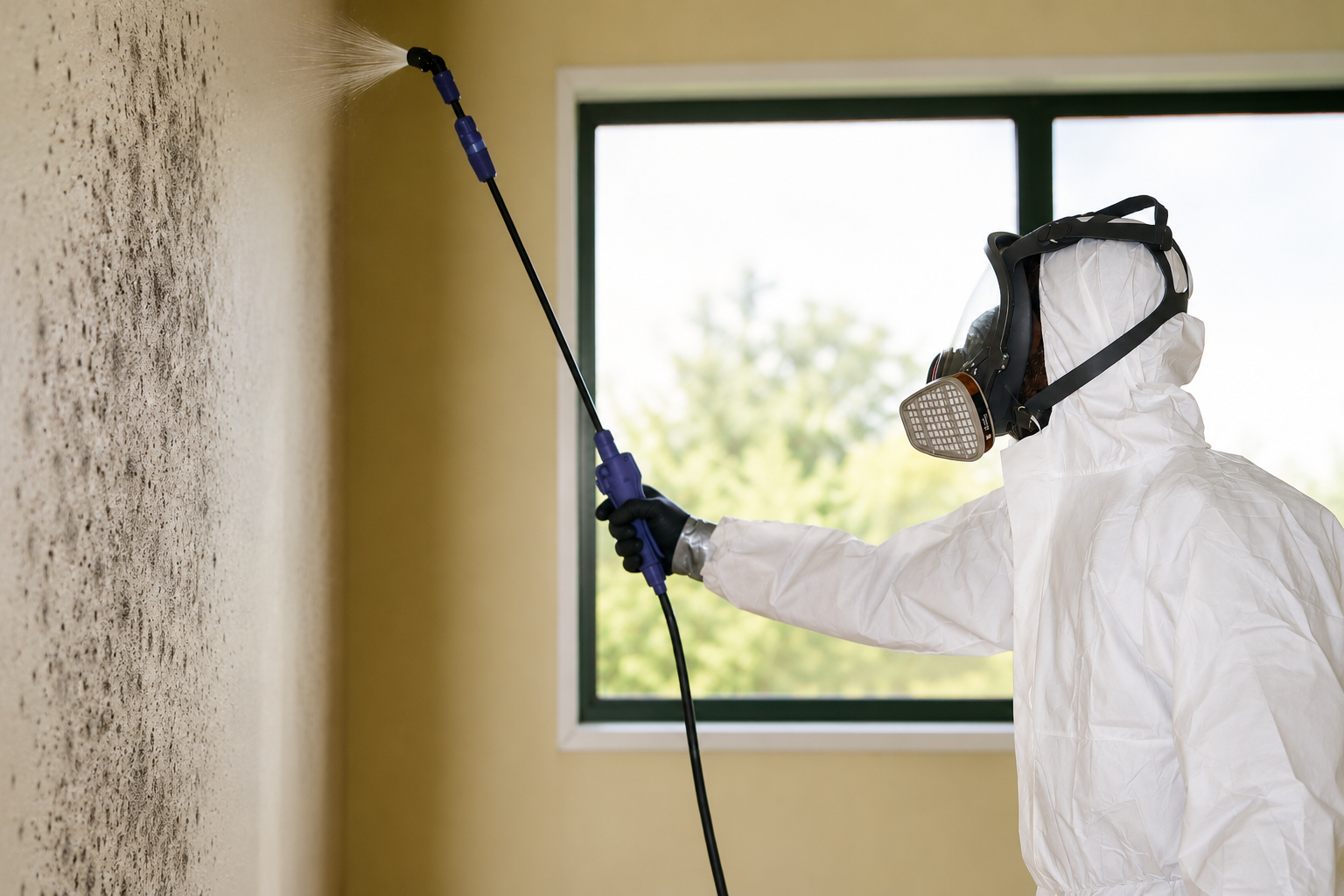
The CDC does not recommend dry or wet fogging as a standalone disinfection approach. The core problem is unchanged: if surfaces have not been manually cleaned first, fogging cannot disinfect what is hiding under organic matter. Chemical mist landing on dirty surfaces is ineffective
What Is the Correct Technique for Cleaning High-Touch Points?
- Blue cloths for general areas
- Green cloths for kitchen and eating areas
- Red cloths for washrooms
- Yellow cloths for toilet cubicles
What Should NZ Workplaces Do During an Infectious Outbreak?
Step 1: Gather Information and Zone the Building
Zone | Risk level | Examples | Cleaning response |
Zone 1 | Highest risk | Desk, workstation, washroom, lunchroom used by affected person | Full clean and disinfect all relevant hard surfaces |
Zone 2 | Close-contact risk | Areas used by close contacts | Clean and disinfect all likely-touched surfaces |
Zone 3 | Transit risk | Corridors, lifts, stairwells, entrances | Focus on door handles, push plates, lift buttons, handrails |
Zone 4 | Preventative | Rest of the building | Thorough high-touch point preventative clean |
Step 2: Mandatory Two-Step Cleaning With Correct Disinfectants
Step 3: Correct PPE Is Mandatory
- Hair net
- Protective eyeglasses
- P2 respirator mask
- Apron or gown
- Strong gloves (changed between zones)
Step 4: Document Who Was On-Site and Follow Up
A professional cleaning company should maintain records of each staff member’s name, contact details, the date and time of the clean, the specific floor or area they worked in, and the names of colleagues they worked alongside. If a health authority ever needs to trace a contact, or if a cleaner develops symptoms in the days that follow, this information becomes essential.
Step 5: Validate the Clean
A decontamination clean is not finished until it is verified. UV fluorescent markers placed on high-touch points before the clean confirm thorough physical removal when checked with a UV torch afterward. ATP testing — which measures organic matter remaining on a surface — provides additional quantitative evidence that cleaning standards were met.
How Do You Build a Workplace Hygiene Maintenance Plan That Actually Works?
For a standard commercial office, this means a daily preventative clean that prioritises high-touch points, with the highest-traffic surfaces cleaned at minimum three times per day.
Your hygiene plan should document:
- Specific cleaning agents and disinfectants used, and their required dwell times
- Colour-coded cloth assignments per zone
- Laundering protocols for reusable equipment
- Cleaning frequencies by surface type and risk level
- PPE requirements for each task
- Staff training records and induction dates
- Monitoring and audit schedule
- Decontamination response procedure
One practical way to embed accountability at the ground level is to nominate a site hygiene champion within the cleaning team — a person responsible for checking that procedures are being followed, that supplies are stocked, that cloths are being handled and laundered correctly, and that teammates are coping both physically and mentally with the demands of the role. This is not a manager. It is someone on the floor, working alongside the team, who takes genuine ownership of standards. At QualGroup, this role is built into how we structure and support our on-site teams through the QualClean Academy.
What Does "Medical-Grade Cleaning" Actually Mean in NZ?
Our High-Performance Cleaning (HPC) methodology applies these principles across all the facilities we service, from corporate offices in Hamilton to childcare centres in Tauranga to health facilities in Rotoura.
What Do Clients Actually Experience With This Approach?
“Hayes International has relied on QualGroup for on-site cleaning services for over five years. Their professional, efficient approach and commitment to customer satisfaction make them our preferred choice.” — Hayes International
The difference clients notice is not just a clean-looking space. It is lower rates of staff illness, greater confidence in their facility’s safety, and a cleaning team that can actually explain what they are doing and why. That transparency is only possible when the process is evidence-based.
Ready to Move from Looking Clean to Being Clean?
If your current cleaning plan cannot tell you what disinfectant is being used, at what dilution, and how long it is left on surfaces — it is not an infection-control plan. It is a schedule.
Or call us on 0800 800 353 to speak directly with our team.
Vijo Madappilly Jose is an infection prevention and control specialist and the founder of QualGroup. He holds qualifications in Infection Prevention and Control from Waiariki Institute of Technology, Rotorua, and previously worked as a registered nurse. QualGroup operates the QualClean Academy to ensure all cleaning staff are trained to validated, evidence-based infection-control standards.
FAQs: Sanitisation and Disinfection for NZ Workplaces
Yes — a decontamination clean is appropriate and important after a confirmed illness. But it should be followed by an ongoing preventative cleaning plan. A one-off clean returns the facility to a baseline; a maintenance system keeps it there.
At minimum, the most frequently touched surfaces — door handles, lift buttons, shared equipment — should be cleaned three times per day in a busy office. In higher-risk environments like childcare or aged care, all hard surfaces should be treated as high-touch points and cleaned with corresponding frequency.
Fogging alone is not recommended as a primary disinfection method, particularly in environments with young children. Chemical aerosols carry real health risks for developing respiratory systems. Manual cleaning with child-safe, residue-free products is the appropriate approach for childcare cleaning.
For routine cleaning, a hospital-grade disinfectant with confirmed efficacy against the relevant pathogens, used at the manufacturer’s recommended dilution and dwell time. For decontamination cleans, the product should be registered as virucidal. Your cleaning provider should be able to name the specific products, their active ingredients, and their required contact times.
Ask for validation evidence. UV fluorescent marker testing and ATP surface testing are the two standard tools for verifying the completeness of a decontamination clean. If a cleaning company cannot offer either, the clean has not been validated.
Yes. QualGroup provides commercial cleaning services across the Bay of Plenty and Waikato regions, including Tauranga, Hamilton, Whakatane, Taupo, and surrounding areas.