For most facility managers, the carpet cleaning conversation starts with one question and quickly becomes two: “Can you clean the carpets?” is immediately followed by “Can you do it without affecting our staff or clients?”
The method matters. The timing matters equally. A technically excellent carpet clean that leaves your office wet at 8:00 am, or your childcare centre smelling of chemicals during nap time, is not a good outcome, regardless of how thoroughly the cleaning was done.
This article explains the main commercial carpet cleaning methods, which work best for which environment, how to handle the most common workplace stains, and how to schedule the work, so your business never misses a beat.
Why Commercial Carpet Cleaning Is Different from a Home Clean
Domestic carpet cleaning is a relatively straightforward, one method, one schedule, minimal disruption. Commercial carpet cleaning is a different problem entirely.
Workplace carpets deal with high foot traffic, outdoor grit tracked in from carparks, coffee and food spills, chair wheel marks, printer toner, body oils on reception chairs, and in some facilities, bodily fluids and clinical waste. They need to be cleaned more frequently, to a higher standard, and without disrupting the people who work in the space.
The other difference is accountability. At home, wet carpets are an inconvenience. In a childcare centre with children arriving at 7:30 am, or a medical clinic opening at 8:00 am, wet carpets are a health and safety issue. The cleaning provider must understand that constraint before they pick up a machine.
What Is the Best Method for Commercial Carpet Cleaning?
There is no single best method and any company that tells you otherwise is oversimplifying. The right method depends on carpet type, soil level, stain type, how much drying time is available, and when the facility next opens. Here is how the four main methods compare:
Steam Cleaning (Hot Water Extraction)
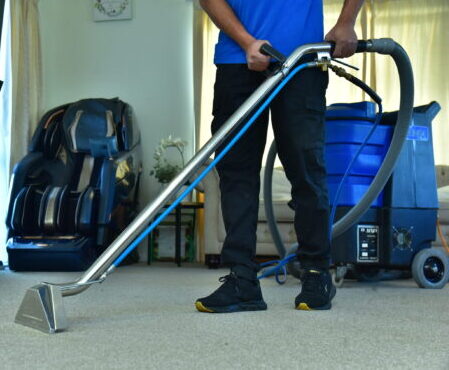
Hot water and cleaning solution are injected deep into the carpet pile and then extracted along with soil, stains, and contaminants. This is the most thorough clean available.
Best for: Annual or periodic deep cleaning, heavily soiled carpets, odour issues, end-of-lease cleaning, or carpets that have not been professionally cleaned for some time.
Drying time: Longer, typically several hours, depending on ventilation and carpet thickness. Best scheduled after hours or over a weekend.
Limitation: Not suitable when carpets need to be walked on quickly. Over-wetting by an inexperienced operator can cause shrinkage or mould growth.
What Is Encapsulation Carpet Cleaning?
A polymer-based cleaning solution is applied to the carpet. It surrounds soil particles, crystallises as it dries, and is then vacuumed away. It uses significantly less water than steam cleaning.
Best for: Regular planned maintenance of large office floors, high-traffic walkways, and carpet tiles. It is one of the most practical methods for ongoing commercial maintenance programs.
Drying time: Short, typically one to two hours.
Limitation: Not suitable for heavily soiled or neglected carpets where deep extraction is needed. Works best as part of a maintenance schedule combined with periodic steam cleaning.
Bonnet Cleaning
A rotary machine fitted with an absorbent pad scrubs the surface layer of the carpet. It improves appearance quickly and is commonly used in hotels and commercial reception areas.
Best for: Quick appearance improvement between deeper cleans, light to moderate surface soil, short turnaround situations.
Drying time: Short.
Limitation: Surface-level only. Used repeatedly without deeper cleaning, it can push soil further into the pile and eventually compact it. Best as an interim method, not a long-term solution.
Dry Compound Cleaning
A moistened absorbent compound is worked into the carpet, attracts soil, and is vacuumed out. Minimal to no water is used.
Best for: Facilities where any moisture is a problem, aged care corridors that must remain open, areas with very tight access windows, or environments where carpets must be walked on immediately after cleaning.
Drying time: Minimal, carpets can usually be used almost immediately.
Limitation: Not suitable for heavily soiled carpets or stain removal. Best combined with periodic extraction cleaning.
How Do You Remove Coffee and Grease Stains from Office Carpets?
The first thing to understand is that a spot and a stain are different problems. A spot is surface contamination, which can usually be removed. A stain has chemically bonded with or dyed the carpet fibre. Using the wrong product on a stain can set it permanently, making it harder or impossible to remove later.
Common stains by workplace type:
Offices: Coffee, tea, ink, printer toner, and mud near entrances. Coffee and tannin-based stains respond well to specific tannin removers not generic dish soap, which can set the stain or leave a sticky residue that attracts more soil.
Childcare centres: Food, paint, playdough, vomit, and urine accidents. These require enzyme-based cleaners that digest organic matter safely. Standard cleaning chemicals are not appropriate in environments where children are crawling on or sitting directly on carpet surfaces.
Aged care facilities: Incontinence-related stains, food spills, and wheelchair tracking marks. Hospital-grade enzymatic cleaners and odour-neutralisation are both required; surface deodorising alone does not address the underlying contamination.
Healthcare clinics: Body oils on waiting room chairs, drink spills near reception, and soil tracked from footwear. Prompt treatment matters here; the longer a stain sits, the harder it is to reverse.
One important note: professional treatment can improve or significantly reduce most stains, but not every stain can be fully removed. Age of the stain, previous cleaning attempts, carpet fibre type, and whether a chemical reaction has occurred all affect the outcome. A good cleaning provider will tell you this honestly before they start.
Why Is After-Hours Carpet Cleaning Important for Businesses?
The answer is straightforward: because most carpet cleaning methods require drying time, and damp carpets during business hours create slip hazards, chemical odour, and staff inconvenience that simply are not acceptable.
After-hours scheduling, evenings, overnight, or weekends, solves this entirely when it is planned properly. The carpets are cleaned within an agreed time window, air movers are used where needed to accelerate drying, and the space is ready before anyone arrives the next morning.
What makes after-hours cleaning work in practice is communication, not just timing. Before the job, the cleaning provider needs to confirm:
-
Exact access times and any security or alarm requirements
-
Which areas to prioritise if the time window is tight
-
Furniture that needs to be moved in advance
-
Where power and water are accessible
-
Whether the site opens early the next morning, and what the hard deadline is
After the job, a professional provider leaves clear handover notes confirming what was completed, any stains that need follow-up attention, and a recommendation for when to vacuum once fully dry.
At QualGroup, after-hours carpet cleaning is standard practice across our commercial contracts, not an exception we make reluctantly. We understand that the schedule is part of the service. See our carpet cleaning services here.
Which Method Is Right for Your Facility?
Offices and corporate spaces: Encapsulation for routine maintenance, steam cleaning for annual or periodic deep cleans scheduled over a weekend.
Childcare centres: Hot water extraction, where hygiene and spills are a primary concern, is planned carefully around operating hours. Enzyme-based spotting for organic stains.
Aged care facilities: Fast-drying methods for corridors and common areas that must remain accessible, with planned deep extraction for rooms that can be temporarily closed.
Healthcare clinics: Low-moisture methods for waiting areas with tight daily schedules, steam cleaning for periodic restorative cleans.
Retail and hospitality: After-hours or overnight cleaning with fast-drying methods where reopening time is non-negotiable.
Why Using One Provider for Everything Makes Sense
Many businesses waste significant time coordinating separate contractors for routine cleaning, carpet cleaning, hard floor care, and window cleaning. Each new contractor needs a site induction, security access, a briefing on expectations, and when something goes wrong, there is always a question of who is responsible.
A capable full-service provider already knows your site, your access requirements, your high-traffic areas, and your standards. Carpet cleaning becomes part of a coordinated maintenance plan rather than a separate project to manage.
At QualGroup, we provide commercial cleaning, carpet cleaning, hard floor care, and decontamination services under one roof. Our clients do not waste time sourcing or vetting multiple contractors. We coordinate the work, handle the scheduling, and manage it reliably because we already understand the facility. That is the QualGroup High-Performance Cleaning approach in practice.
What Our Clients Say
“Have dealt with QualGroup at our childcare centre in Rotorua for several years. They are a professional company, offering a good service and are always happy to go the extra mile for us. Highly recommend their services.” — Client Google Review
For a childcare centre where carpet hygiene is directly linked to child health, that consistency and willingness to go further than expected is exactly what the role demands.
Ready to Stop Coordinating Multiple Contractors?
QualGroup provides professional commercial carpet cleaning across offices, childcare centres, aged care facilities, healthcare clinics, retail spaces and commercial properties throughout the Bay of Plenty and Waikato regions, including Tauranga, Hamilton, Rotorua, Whakatane, and Taupo.
We will provide a tailored cleaning plan and free quote designed to meet your business’s specific needs, helping you maintain a clean, safe, and compliant environment.
Contact our team to plan your carpet cleaning schedule → Or call us on 0800 800 353.
FAQs: Commercial Carpet Cleaning in NZ Workplaces
-
What is the best carpet cleaning method for commercial carpets?
There is no single best method. Steam cleaning is best for deep extraction and heavily soiled carpets. Encapsulation suits regular commercial maintenance. Bonnet cleaning improves appearance quickly. Dry compound cleaning is best where drying time must be minimal. The right choice depends on carpet condition, soil level, and how long the space can be out of use.
-
What is encapsulation carpet cleaning?
A polymer solution is applied to the carpet, surrounds soil particles, and crystallises as it dries. The crystals and the soil trapped inside are then vacuumed away. It offers fast drying and is well-suited to regular commercial maintenance programs.
-
Can commercial carpet cleaning be done after hours?
Yes, and for most commercial facilities, it should be. After-hours scheduling eliminates disruption, allows proper drying time, and ensures the space is ready before staff or clients arrive.
-
Can all carpet stains be removed?
Not always. Professional treatment can improve or remove many stains, but outcomes depend on stain type, age, carpet fibre, and whether previous cleaning attempts have set the stain. A reputable provider will give you an honest assessment before starting.
-
How often should commercial carpets be cleaned?
High-traffic areas such as entrances and corridors typically need regular maintenance cleaning plus periodic deep extraction. Lower-traffic areas need less frequent attention. The right schedule depends on foot traffic, carpet colour, industry type, and hygiene requirements.